
Agency Intelligence: roster context and partnership posture
How Cultiq connects an artist to their agency, related acts, operational context, commercial posture, and the brand implications of the wider roster.


- An artist can be an excellent brand fit while the proposed timing, category, or deal structure is a poor fit for the agency context.
An artist partnership is rarely managed by the artist alone. Agency structure, roster strategy, approval behavior, operational stability, and related acts can shape the deal. Cultiq’s Profile tab brings that context into the artist read.
Why the agency belongs in artist evaluation
Creative fit lives with the artist. Execution depends on the operating system around them: representation, approvals, schedule coordination, commercial strategy, and the wider roster.
The Agency Intelligence card sits in the Profile tab to make that layer visible before a brand reaches the commercial conversation.
TakeawayAn artist can be an excellent brand fit while the proposed timing, category, or deal structure is a poor fit for the agency context.
Agency identity and operating context
Start with the agency name and available profile. Confirm the artist’s representation and review the broader agency page where available.
Useful questions include:
- What kinds of talent does the agency represent?
- Is the roster concentrated or diverse?
- Does the agency have experience in the target market?
- Are there visible category patterns across its artists?
- How complex might approvals and coordination be?
These are planning questions, not claims about unpublished internal policy.
Partnership posture
Agency posture is a strategic frame describing how the artist and agency may approach brand opportunities: global expansion, luxury adjacency, high-volume endorsement, selective cultural partnerships, or emerging-market development.
Use the posture to guide the first commercial hypothesis. It should not be mistaken for confirmed availability or willingness.
Why the agency matters to brands
The “Why This Matters” framing translates agency and artist context into brand implications.
It may surface:
- Market access.
- Roster leverage.
- Approval complexity.
- Category credibility.
- Multi-artist possibilities.
- Operational stability.
The useful outcome is a better question for the agency, not an assumption made without them.
Other artists at the agency
Roster context helps a brand see alternatives and peers. If the preferred artist is unavailable, another act at the same agency may offer similar market access with a different audience, tier, or budget posture.
Review related acts for:
- Audience differences.
- Category fit.
- Market specialization.
- Career stage.
- Cross-roster campaign potential.
Do not assume the list is curated unless the profile makes that clear. When no editorial seed exists, the product may show the live agency roster.
Operational stability
Profile intelligence can include signals relevant to execution: artist activity, roster continuity, schedule intensity, and agency context.
Operational stability should inform:
- Lead time.
- Approval milestones.
- Contingency planning.
- Deliverable complexity.
- Whether the campaign depends on one member or the full group.
Use agency pages for horizontal research
Artist profiles provide a vertical deep dive. Agency pages provide a horizontal roster view.
This is useful when:
- The brief needs several alternatives.
- A multi-artist campaign is being considered.
- The brand wants one operational relationship across several acts.
- Agency reputation or market reach matters to execution.
Build the agency note
For each finalist, capture:
- Agency
- Partnership posture
- Operational advantage
- Approval or schedule concern
- Related artist alternative
- Question to validate directly
Common mistakes
- Treating roster membership as endorsement of a particular deal.
- Assuming related artists have interchangeable audiences.
- Inferring fees or terms from agency size.
- Ignoring category conflicts across the roster.
- Treating AI-assisted posture as an internal agency statement.
- Forgetting that current representation can change.
Use context without overclaiming
Agency Intelligence improves preparation. It cannot replace a conversation with representation. Its value is helping the brand arrive with a clearer brief, more realistic timing, and better alternatives.
Browse agency pages or open the Profile tab on an artist.
Frequently asked questions
No. It provides context and strategic framing; actual availability, approvals, and terms require direct engagement.
Roster context helps teams understand peer positioning, possible alternatives, and the broader commercial environment around the artist.
When a curated seed is absent, Cultiq can fall back to the live agency roster, so the list may reflect catalog data rather than an editorial recommendation.

Music Intelligence: platforms, genre, tracks, awards, and tour context
A feature walkthrough of the Cultiq Music tab and how brands can read platform performance, streaming, genre, mood, tracks, awards, tours, and live music signals.
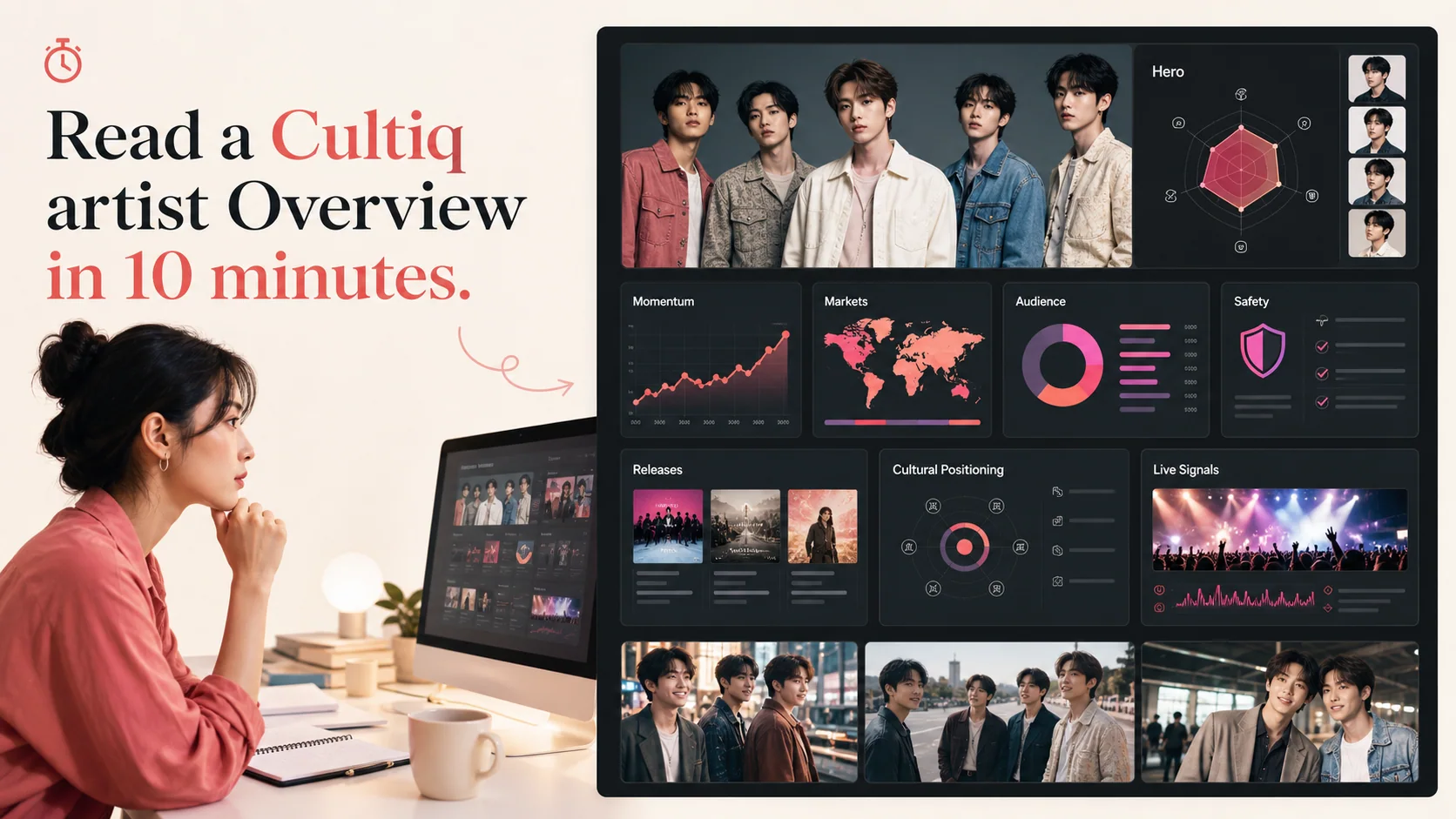
Read a Cultiq artist Overview in 10 minutes
A guided tour of the artist Overview: brand fit, momentum, audience, markets, safety, releases, cultural positioning, recommendations, and live signals.

Scout rising artists in Cultiq: a five-step workflow
A workflow for turning a campaign brief into a defensible shortlist of rising K-Pop, C-Pop, J-Pop, and Thai artists — using discovery, audience, momentum, and fit.