
Localize an artist partnership brief across markets
Turn one global artist idea into market-specific briefs for the US, UK, Japan, and South Korea without losing the campaign’s core logic.
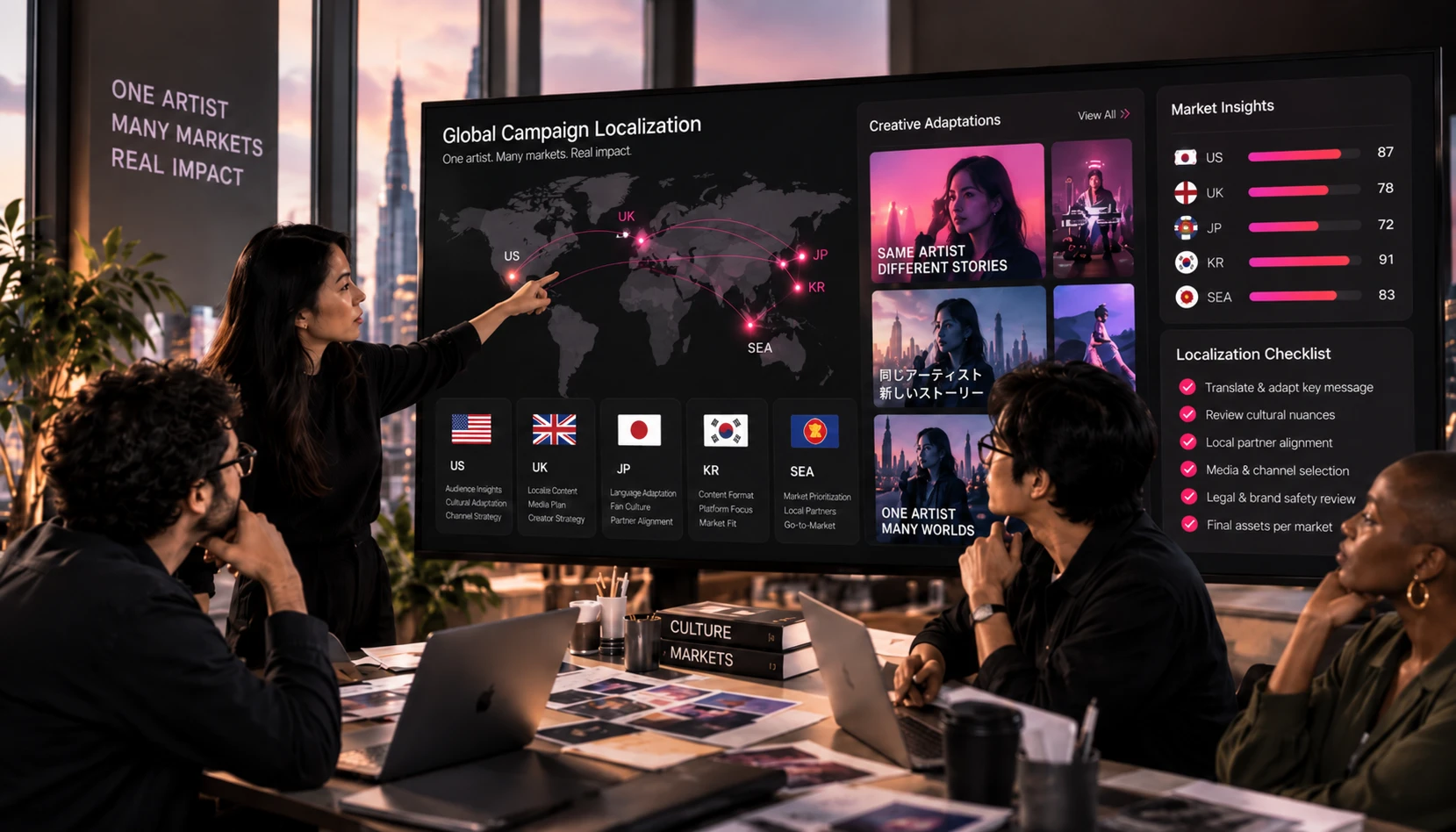

- Localize the execution, not the reason. Every market brief should be able to explain why the same artist still serves the same campaign objective.
- A localization choice is strongest when the evidence, strategic continuity, and verification owner are visible together.
A global artist partnership needs one strategic spine and several local operating briefs. Use Cultiq to decide what stays fixed, what changes by market, and which assumptions require local verification.
A global campaign can look aligned in a leadership deck and still fail at market level. The artist may be well known in Seoul but need explanation in New York. A creative idea that feels natural in Tokyo may need a different participation mechanic in London. Rights cleared for social video may not cover retail, paid media, events, or local partners.
The answer is not to invent a separate campaign for every country. It is to preserve one decision logic while making local differences explicit. Cultiq gives brand and agency teams a shared place to compare artist fit, audience and market context, cultural positioning, music or screen evidence, momentum, and risk before commercial outreach.
TakeawayLocalize the execution, not the reason. Every market brief should be able to explain why the same artist still serves the same campaign objective.
Write the global spine first
Begin with a short statement that survives every market version. It should name the business objective, the artist’s campaign role, the intended audience change, and the decision window.
Build consideration for a consumer-technology launch by using an artist as a credible bridge between music culture and everyday creativity during the fourth quarter.
That sentence does not promise reach, availability, or performance. It establishes the job. If the United States brief is about product trial while the Japan brief is about prestige awareness, the team may be running two strategies under one artist name. Surface that difference before creative development.
Keep these elements fixed unless leadership intentionally changes the strategy:
- The business objective.
- The artist’s strategic role.
- The brand behavior the partnership should demonstrate.
- The primary success question.
- The evidence standard used to approve the partner.
This shared spine prevents local teams from optimizing toward unrelated outcomes simply because their channels and cultural contexts differ.
Separate artist origin from campaign market
Artist origin is catalog context. Campaign market is where the brand needs the partnership to work. They can overlap, but one does not prove the other.
A Korean artist may be relevant to a United States launch. A British artist may have a useful role in Japan. A global campaign may prioritize New York, London, Tokyo, and Seoul for different commercial reasons. Start with the buyer and audience need in each location, then ask whether the artist has evidence that supports that need.
| Planning field | Global question | Local question |
|---|---|---|
| Objective | What business change should the partnership support? | How does that change appear in this market? |
| Audience | Who should respond to the artist association? | Which local segment, behavior, or cultural community matters? |
| Artist role | Why is this artist essential to the idea? | Which part of the artist’s relevance is legible here? |
| Activation | What should people experience or do? | Which channel, format, partner, or venue makes that action credible? |
| Measurement | What would count as progress? | Which local indicator can be measured consistently and responsibly? |
Do not convert a broad regional label into proof. “Strong in Asia,” “global fandom,” or “popular with Gen Z” is too coarse for a market investment decision.
Build a market evidence card
Create one compact evidence card for each priority market. The card should distinguish what Cultiq shows, what the team infers, and what remains unknown.
Use the artist Overview and Intelligence areas to collect only decision-relevant signals:
- Audience context: Which visible audience, platform, or demographic signals are relevant to this market?
- Market context: What does Market Coverage or the Market Activation Matrix suggest is worth investigating?
- Cultural route: Which music, screen, fashion, live, or community context makes the partnership understandable locally?
- Current timing: Do momentum, releases, tours, public activity, or Live Signals create a useful window or a reason for caution?
- Evidence gap: Which critical claim is modeled, AI-assisted, dated, absent, or dependent on first-party confirmation?
Label interpretation as interpretation. A platform signal can justify a research question; it does not establish local conversion, category availability, or commercial intent.
Decide what changes by market
Local teams need permission to change the parts that affect comprehension and execution. They should not quietly change the strategy.
| Brief element | Usually fixed | Adapt when evidence supports it |
|---|---|---|
| Campaign objective | Yes | Only through an explicit strategic decision |
| Artist role | Mostly | Clarify the locally relevant facet of that role |
| Core creative platform | Mostly | Adapt expression, participation, and cultural references |
| Channel mix | No | Match local media behavior and available assets |
| Language and copy | No | Localize meaning, tone, and regulatory requirements |
| Timing | No | Account for releases, tours, retail calendars, holidays, and approvals |
| Deliverables and rights | No | Define territory, media, term, usage, and local partner needs |
| Success indicators | Partly | Keep a comparable core and add market-specific measures |
For example, one partnership could use creator-led product demonstrations in the United States, a fan-community editorial format in the United Kingdom, a retail-and-content sequence in Japan, and a live or release-linked moment in South Korea. Those are execution hypotheses. They still need audience evidence, artist approval, rights, production, and local feasibility checks.
Use a change test for every localization
Every local variation should pass three questions:
- Evidence: What market fact or audience need requires this change?
- Continuity: How does the change preserve the global objective and artist role?
- Verification: Who must confirm the cultural, legal, operational, or commercial assumption?
If the team cannot answer the first question, the change may be personal preference. If it cannot answer the second, the local plan may have drifted into a different campaign. If it cannot answer the third, an assumption is being treated as approval.
TakeawayA localization choice is strongest when the evidence, strategic continuity, and verification owner are visible together.
Pressure-test the artist across all briefs
Do not approve the artist globally and evaluate markets afterward. Compare the same candidate against every local brief before the commitment becomes emotionally fixed.
FitMatrix can help teams apply a consistent evaluation lens, but the useful output is the pattern of strengths, weaknesses, and unknowns—not one blended score. An artist may have excellent Creative Fit across all four markets, strong Market Coverage in two, and limited evidence in the others. That can support a phased rollout, a narrower rights package, or a different candidate. It does not support pretending the gaps are equal to zero or automatically solved by global fame.
Review at least these trade-offs:
- Strong artist identity but weak local evidence.
- Strong local audience context but a poor campaign-role match.
- Timely momentum but insufficient production runway.
- Clear cultural relevance but unresolved category conflicts.
- Broad recognition but an activation that depends on rights not yet discussed.
Use the market coverage guide when the team needs to interpret market readiness without converting directional intelligence into certainty. For direct candidate comparison, test cross-market audience fit before finalizing the brief set.
Package four local briefs, not one bloated document
A global master document often becomes too abstract for local operators and too detailed for executive review. Use a one-page shared spine plus one concise brief per market.
Each local brief should contain:
- The unchanged global objective and artist role.
- The local audience and behavior to influence.
- The market-specific evidence supporting the plan.
- The creative expression and activation hypothesis.
- Required deliverables, channels, territory, and timing.
- Open questions on availability, rights, fees, conflicts, approvals, and production.
- A decision owner, verification owner, and next review date.
Keep assumptions visible. “Proposed,” “to verify,” and “subject to representation approval” are productive labels. They prevent an early creative direction from hardening into a commercial promise.
Choose a rollout shape
The evidence may not support simultaneous launch in every market. Select the rollout that matches the confidence level.
| Rollout | Use when | Main discipline |
|---|---|---|
| Simultaneous | Evidence, assets, rights, timing, and operations are strong across markets | Keep local execution aligned under one decision calendar |
| Phased | Some markets are stronger or operationally ready earlier | Define what the first phase must teach before expansion |
| Pilot market | A key assumption needs real-world validation | Choose a market that can answer the question, not merely produce attention |
| Tiered activation | Markets merit different investment or formats | Avoid implying lower-investment markets are strategically identical |
A phased plan is not a weaker global ambition. It can be the more responsible decision when local evidence and commercial feasibility mature at different speeds.
Common localization mistakes
- Copying one brief into four documents. Translation is not market strategy.
- Changing the objective without saying so. Local execution drifts into unrelated campaign goals.
- Treating artist origin as local demand. Heritage or scene context does not prove buyer-market response.
- Using fame as a universal solvent. Recognition cannot resolve weak creative fit, rights, timing, or category conflict.
- Hiding unknowns in polished language. An elegant deck does not convert an assumption into evidence.
- Clearing creative before commercial scope. A concept may depend on media, territory, duration, appearances, or content rights that are unavailable.
- Measuring every market identically. A common core supports comparison, but local objectives may require additional indicators.
Make the market differences reviewable
The purpose of localization is not to maximize variation. It is to make the same partnership strategically legible and operationally credible in each priority market.
Start with one global spine. Build a dated evidence card for the United States, United Kingdom, Japan, South Korea, or whichever high-value markets the brief genuinely prioritizes. Adapt only what the evidence requires, assign owners to every verification gap, and choose a rollout shape that matches confidence.
When the local briefs are aligned, open Artist Discovery to compare candidates against the same campaign logic, then review the match-request workflow without implying confirmed deal conditions. Availability, interest, rights, fees, conflicts, deliverables, approvals, and terms remain matters for authorized representatives.
Frequently asked questions
Not automatically. Keep the campaign objective and partnership logic consistent, then adapt audience framing, channels, cultural context, timing, rights, and execution where evidence supports a change.
No. Global visibility and artist origin do not prove local audience concentration, buyer intent, cultural relevance, or campaign performance.
No. Cultiq helps structure fit and market questions. Availability, rights, fees, conflicts, approvals, deliverables, and terms require confirmation from authorized representatives.
Create a local brief when the audience job, cultural framing, channel plan, timing, activation, rights, or approval path materially differs from the global plan.

Read the musical-characteristics radar correctly
Use Cultiq’s five-axis music radar as qualitative catalog context without presenting estimated characteristics as measured audio data.

Explain a FitMatrix recommendation to executives
Turn a Cultiq artist comparison into an executive-ready recommendation without presenting a score as certainty.

Document why an artist left your shortlist
Use Cultiq evidence to record why an artist was removed, what changed, and when the decision deserves a fresh review.