
Read a Cultiq artist Overview in 10 minutes
A guided tour of the artist Overview: brand fit, momentum, audience, markets, safety, releases, cultural positioning, recommendations, and live signals.
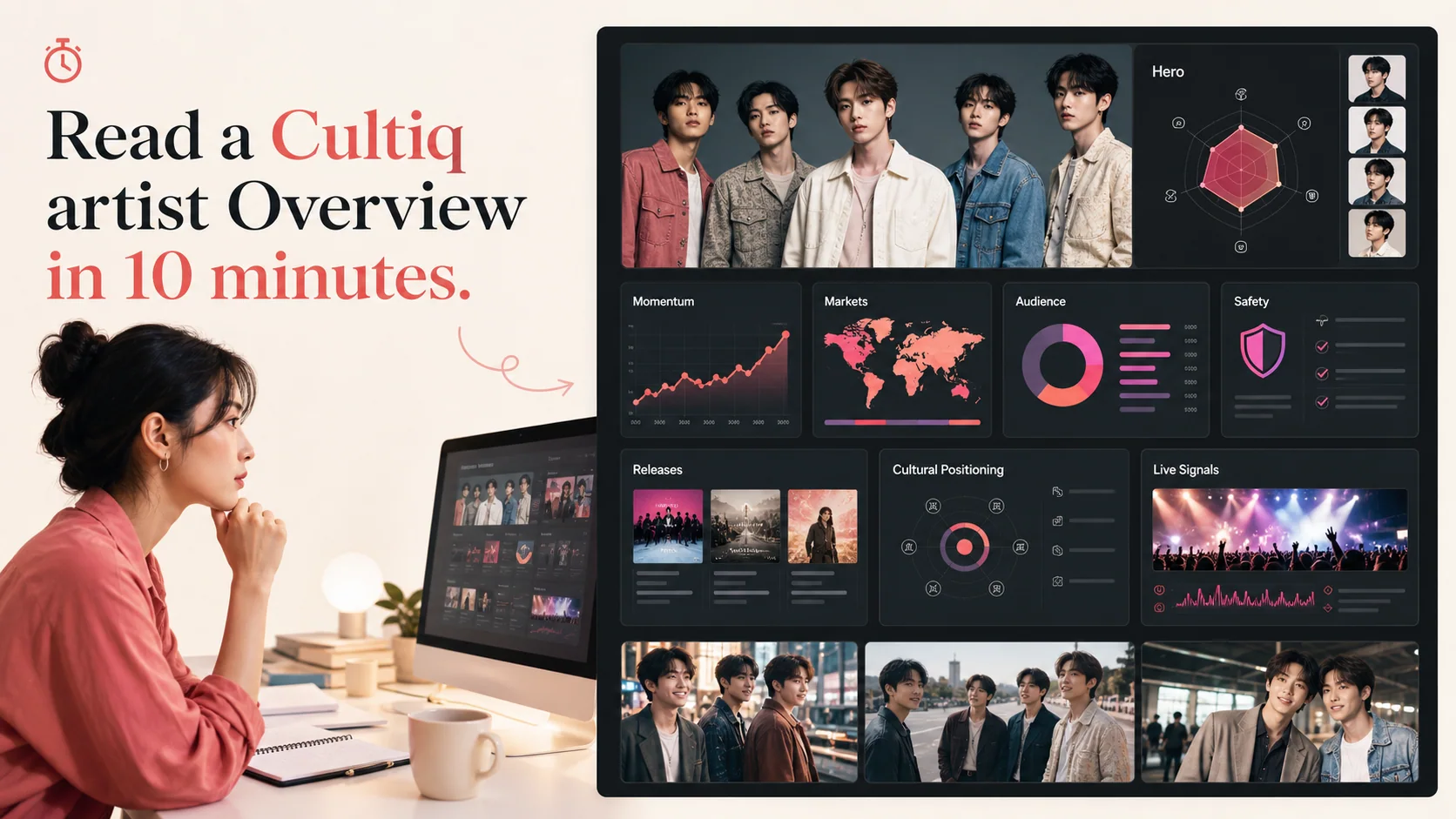

- The Overview is a triage surface, not a shortcut around due diligence.
The Overview is designed for the first serious read of an artist. It compresses the most important evidence from several deeper tabs into one page, so you can decide what deserves investigation—and what does not—before opening every card.
What the Overview is for
An artist profile contains more information than a first decision needs. The Overview pulls the most decision-relevant signals forward: who the artist is, why the current moment matters, where the audience sits, how the brand fit reads, and what risks or unknowns deserve attention.
Use it to answer one question:
Is there enough evidence of relevance to justify a deeper evaluation?
TakeawayThe Overview is a triage surface, not a shortcut around due diligence.
Minute 1: read the hero
Start with the identity, tier, category, agency, and headline signals. Confirm you are evaluating the right artist and understand the basic market position.
If your brand profile is complete, note the brand-specific fit shown in the hero. Treat it as a prompt to inspect the breakdown, not a verdict.
Minutes 2–3: read the current narrative
Look for the current-era or narrative framing. This explains the artist’s present commercial and cultural moment: expansion, comeback, touring, consolidation, reset, or emerging momentum.
Ask whether the moment creates a useful role for your brand. A strong artist can still be in the wrong cycle for the campaign timing.
Minutes 3–4: inspect momentum and top markets
The momentum summary gives direction; top markets give geography.
Check:
- Is the trajectory rising, stable, or cooling?
- Which markets anchor the audience?
- Are your campaign territories represented?
- Does the movement appear broad or dependent on one event?
If the answer matters to the decision, continue in the full Intelligence tab.
Minutes 4–5: scan the audience snapshot
The audience preview summarizes key composition and market information. Compare it with the buyer in your brand profile.
Look for obvious alignment or obvious friction. Do not infer missing demographics. Open the Audience tab when the candidate survives this screen.
Minutes 5–6: check brand safety and trust
Read visible safety, trust, and operational signals. The purpose is not to certify the artist as safe. It is to surface questions early enough to affect the shortlist.
Note:
- Current concern level.
- Any visible controversy or volatility indicator.
- Whether the data is recent.
- What must be human-verified.
Minutes 6–7: scan music and releases
Recent releases, top tracks, and music signals help explain where attention is coming from. A new era or touring cycle can influence timing, content format, and fandom activity.
Use the Music tab for platform performance, genre and mood, tracks, awards, touring, and live music context.
Minutes 7–8: read cultural positioning
The Overview preview can surface the artist’s archetype and current cultural frame. This helps answer whether the partnership would feel native or manufactured.
If the positioning seems promising, open Cultural Positioning to inspect evolution, peers, proof points, brand identity, sentiment, and brand implications.
Minutes 8–9: review recommendations and active deals
Campaign recommendations can suggest plausible activation routes. Active deals help reveal category conflicts, overexposure, or useful commercial precedent.
Treat sample brands or illustrative recommendations as prompts, not claims that a specific company is available or endorsed.
Minute 10: check live signals
The live-signals preview shows what is happening around the artist now. Look for fresh events, sentiment direction, topic velocity, and whether the profile needs a deeper current-state read.
Open the full Live Signals tab before making a timing-sensitive recommendation.
Write the screening note
End the ten-minute review with five lines:
- Reason to investigate
- Strongest market
- Strongest audience or category signal
- Current momentum
- Risk or unknown
Example:
Strong candidate for a Japan-led beauty activation due to audience and category alignment. Momentum is rising around the current release cycle. US reach and schedule availability require validation.
When to stop
Move on when the artist fails a non-negotiable requirement: wrong market, weak category logic, unrealistic scale, or material unresolved risk. More tabs will not rescue a fundamental mismatch.
Continue when the Overview reveals a credible partnership hypothesis that deeper evidence can test.
Open Artist Discovery and choose a profile to evaluate.
Frequently asked questions
No. It is a screening surface. Use the deeper Intelligence, Audience, Music, Cultural Positioning, and Live Signals tabs before a final recommendation.
Cultiq preserves missing-data honesty rather than manufacturing certainty. Empty or stale fields should be treated as items to validate.
Brand-fit surfaces use the signed-in brand profile when enough context is available.

Cultiq Agent: turn a brief into artist recommendations
How to give the Cultiq Agent a useful campaign brief, evaluate its ranked artist recommendations, and move the strongest options into FitMatrix and My Matches.

Build an artist shortlist without defaulting to fame
A practical Cultiq workflow for reducing a broad artist roster to three to five defensible candidates using audience, market, momentum, budget, and risk evidence.

Reading demand: market signals before you commit budget
Where the audience is moving, which categories are heating up, and how to time a partnership window instead of chasing one after it has closed.