
Member Intelligence: plan a group partnership beyond the group name
How Cultiq helps brands understand group members, roles, individual relevance, solo context, and whether a campaign needs the full group or a focused member route.
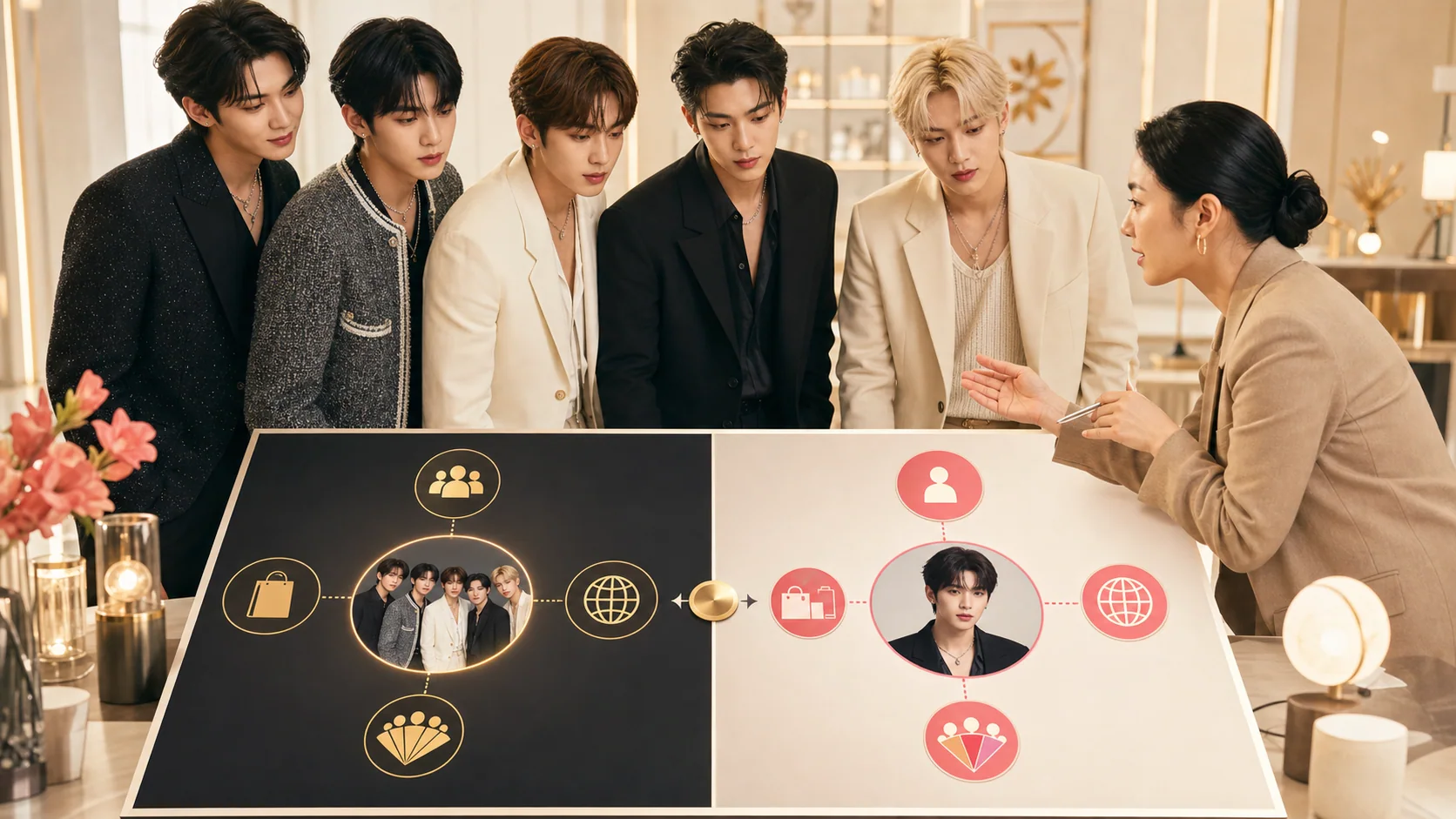

- Choose the full group when collective meaning creates the value. Choose a member-led route when individual relevance makes the campaign more credible.
A group is one brand and several individual public identities. Some campaigns need the full fandom and collective meaning; others become more precise when a specific member’s role, audience, category affinity, or market relevance leads.
The group is not a single undifferentiated audience
Fans follow the group collectively, but member roles can shape different emotional, category, and market associations. A fashion campaign, gaming activation, beauty launch, or local-market event may benefit from a member whose public identity fits the job more precisely.
Member Intelligence gives the first structured read before deeper research and commercial validation.
TakeawayChoose the full group when collective meaning creates the value. Choose a member-led route when individual relevance makes the campaign more credible.
Start with the group case
Before considering members, define why the group fits:
- Audience overlap.
- Priority markets.
- Cultural positioning.
- Current era.
- Category affinity.
- Momentum and risk.
The member route should sharpen a valid group-level hypothesis, not rescue a weak one.
Understand member roles
Public roles—leader, vocalist, rapper, dancer, producer, visual, actor, or variety personality—can influence how audiences understand each member.
Roles are not commercial destinies. They are context for creative development.
Ask:
- Which role supports the product story?
- Does the member have relevant solo activity?
- Is the public identity consistent with the category?
- Would the campaign feel natural to the fandom?
Category relevance
Different members may carry different affinities through fashion activity, beauty visibility, gaming interest, acting work, music production, sport, or local-market recognition.
Use public evidence rather than stereotypes. A member’s appearance alone is not proof of category fit.
Market relevance
Member nationality, language, solo activity, or public presence can affect market resonance. This can be valuable for local activations, but it should be verified with audience and platform evidence.
Do not assume nationality automatically equals market influence.
Group route versus member route
Full group
Best when the campaign needs:
- Maximum collective fandom.
- Group music or narrative.
- Regional awareness.
- A large launch moment.
- Balanced representation.
Member-led
Best when the campaign needs:
- Precise category affinity.
- Local-market relevance.
- A specific creative role.
- A smaller activation format.
- Continuity with solo work.
The commercial structure and rights can differ significantly, so do not infer that a member route is automatically simpler or cheaper.
Read the profile around the member
Use the group’s deeper tabs:
- Audience: who and where.
- Music: catalog and current era.
- Cultural Positioning: collective meaning.
- Intelligence: commercial behavior and active deals.
- Live Signals: current member or group activity.
Member analysis should remain connected to the group context.
Fandom considerations
Member-specific campaigns can generate strong engagement and also sensitivity around perceived imbalance, exclusion, or repetitive selection.
Consider:
- Whether the creative respects group identity.
- How other members appear or do not appear.
- Existing solo endorsements.
- Fandom expectations.
- Whether the activation creates a useful member story.
Build the member decision note
Capture:
- Group-level reason to partner
- Member-specific advantage
- Category evidence
- Market evidence
- Creative role
- Fandom sensitivity
- Availability and rights to confirm
Common mistakes
- Choosing the most-followed member by default.
- Treating public role as audience data.
- Assuming nationality guarantees local reach.
- Ignoring group and fandom dynamics.
- Assuming individual contracting is easier.
- Building a member campaign disconnected from the artist’s current work.
Make the route deliberate
The product decision is not “group or member?” in the abstract. It is which structure creates the strongest audience, cultural, and creative fit for this campaign while remaining executable.
Open a group profile and review its member intelligence.
Frequently asked questions
No. It provides evaluation context; individual availability, rights, and agency approval must be confirmed.
No. The right member depends on category, audience, market, objective, role, and the creative idea.
Yes. Brands should consider group identity, fandom dynamics, agency structure, and whether the activation creates imbalance or confusion.

Compare K-Pop, C-Pop, J-Pop & Thai in one shortlist
A cross-market Cultiq framework for comparing artists fairly without treating Asian entertainment markets as interchangeable or letting raw scale dominate.

How to read an artist audience before choosing a partnership
A hands-on guide to evaluating artist audiences in Cultiq through market concentration, demographics, purchase behavior, affinities, and activation value.

From gut-feel to documented fit: scouting without an agency
How brand teams run their own partnership scouting on a self-serve platform — what the software does, what stays human, and where an agency still earns its place.