
Venue capacity is not demand: right-size a concert with Cultiq
A promoter framework for comparing artist, city, venue, timing, and Event Heat evidence before choosing a show scale or approaching sponsors.


- Choose the smallest venue scenario that credibly serves the show’s objective and evidence—not the largest capacity that makes the deck look impressive.
- A demand case should explain not only who may buy, but how the team will reach them, at what price, over what sales window.
Capacity describes how many people a venue can hold. It does not describe how many tickets a specific artist can sell in a specific city on a specific date. Use Cultiq to structure the evidence, expose assumptions, and compare scenarios.
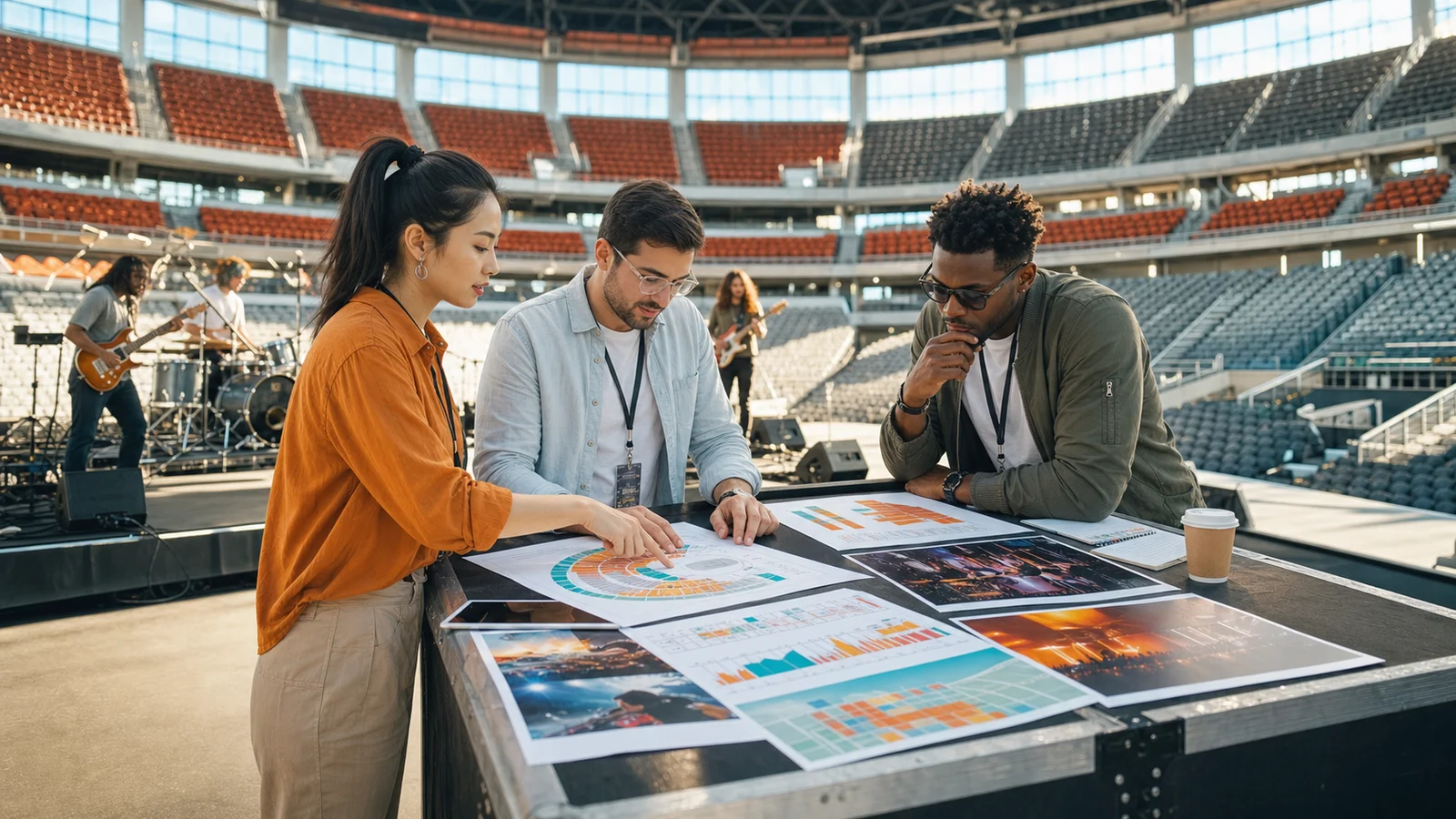
Promoters often meet a familiar planning shortcut: the artist has global attention, the city has an arena, and the sponsor deck needs a large number. Capacity then slips into the proposal as if it were expected attendance.
That is the wrong use of the number. Capacity is a physical limit. Demand is a conditional judgment about an artist–city–venue–date combination. The same artist can support different room sizes in New York, London, Seoul, Tokyo, Paris, or Dubai because local audience depth, routing, timing, price, competition, and promotion change the case.
Cultiq’s concert discovery and Event Heat context can help a promoter structure that judgment. It does not book the venue, confirm an artist, set the ticket price, guarantee a sponsor, or predict a sell-out.
TakeawayChoose the smallest venue scenario that credibly serves the show’s objective and evidence—not the largest capacity that makes the deck look impressive.
Define the decision before comparing venues
Write the show hypothesis in one sentence:
[Artist] in [city] during [date window] should be evaluated at [venue format] because [demand evidence], with success defined as [commercial and audience outcome].
Keep artist origin separate from show market. An artist from South Korea, Japan, Thailand, China, the United Kingdom, or the United States may have cross-market demand, but origin does not prove ticket-buying depth in the target city.
Then define the operating constraints:
- Feasible date window and routing.
- Venue formats available for comparison.
- Ticket-price assumptions.
- Production scale and curfew.
- Marketing resources and sales window.
- Local partners and distribution.
- Sponsor inventory and activation needs.
- Decision deadline and responsible owner.
If these inputs are unknown, mark them as unknown. A neat spreadsheet does not make an assumption true.
Read Event Heat as a breakdown
Open Concert Discovery and inspect the available opportunity context. Event Heat is most useful when its drivers are read separately rather than repeated as a single score.
| Lens | Planning question | What it cannot prove alone |
|---|---|---|
| Audience demand | Is there evidence of audience pull around this artist and market? | Paid ticket conversion |
| Ticket velocity | Is the available sales signal moving at a useful pace? | Future sales under a different price or date |
| Brand lift | Could the event create meaningful sponsor association? | Sponsor budget, interest, or approval |
| Market fit | Does the artist–market connection appear strategically relevant? | Venue-scale readiness |
| Venue and date context | Is the proposed setting operationally plausible? | Availability, hold status, or final terms |
Two opportunities can show similar composite heat for different reasons. One may have stronger audience pull but weaker sponsor logic. Another may have attractive market fit but an uncertain date or venue case. The breakdown tells the promoter what to validate next.
Do not use a directional score as a sales forecast. Do not describe historical or public signals as live inventory. And do not translate missing data into a low-value zero.
Build five demand lenses
1. Artist evidence
Review the artist profile for tier, audience context, market coverage, momentum, platform signals, and available tour history. Ask which signals are current, which are historical, and which are AI-assisted interpretations requiring review.
An artist’s global scale can justify attention, but it does not determine the correct room. A rising artist with concentrated local relevance may support a stronger city case than a larger artist with shallow market evidence.
2. City evidence
Define why this city belongs on the route. Useful questions include:
- Is there audience evidence tied to the country or city?
- Has the artist shown meaningful live or cultural relevance nearby?
- Is the city a priority for the artist, promoter, or sponsor?
- Are audiences likely to be local, regional travelers, or international visitors?
- Does the market have practical ticketing and promotion channels for the act?
Avoid using broad labels such as “global fandom” as a substitute for local proof.
3. Venue evidence
Compare venue format, configuration, location, production fit, access, curfew, and realistic sellable inventory. The published maximum capacity may not equal the usable configuration after staging, sightlines, holds, accessibility, hospitality, sponsor footprints, and production kills.
Confirm those details with the venue. Cultiq can help frame the choice; it does not replace a technical or commercial venue conversation.
4. Timing evidence
Test the date window against artist routing, release activity, local calendars, competing events, holidays, weather, visa or logistics requirements, and the sales runway. Public tour context may show a useful moment, but it does not confirm a hold or schedule.
A strong artist–city match can still be the wrong show on the wrong date.
5. Execution evidence
Demand is not independent of execution. Record the ticket strategy, promoter reach, media plan, fan-community access, local partnerships, distribution, content plan, and on-sale sequence. If the scenario requires marketing resources the team does not have, the venue choice is carrying hidden risk.
TakeawayA demand case should explain not only who may buy, but how the team will reach them, at what price, over what sales window.
Compare three venue scenarios
Build three scenarios under the same artist, city, and date assumptions.
| Scenario | Role | Core question |
|---|---|---|
| Focused | Protect atmosphere and downside | What is the most defensible scale if demand is softer than hoped? |
| Base | Match the current evidence | Which format best balances audience, economics, and production? |
| Expansion | Capture upside | What additional proof must exist before moving larger? |
For each scenario, document:
- Venue format and realistic sellable range.
- Evidence supporting that scale.
- Ticket-price and sales-window assumptions.
- Marketing and distribution requirements.
- Production and sponsor implications.
- Leading indicators to monitor.
- The trigger to proceed, resize, reroute, or retime.
Do not invent exact attendance, revenue, or conversion rates merely to fill the model. Use ranges only when your team has a defensible source and label the basis. If no reliable range exists, compare the scenarios qualitatively and identify the research needed.
Add sponsor logic after the show logic
A sponsor can strengthen an event, but sponsor interest should not be used to conceal a weak demand case. First decide whether the show deserves to exist at the proposed scale. Then test what a partner could credibly enable.
Review:
- Audience relevance to the sponsor category.
- The fan action the partner would improve.
- On-site footprint and operational feasibility.
- Content, hospitality, ticketing, and data possibilities.
- Category conflicts and exclusivity.
- Artist participation and approval requirements.
- Rights, territory, term, measurement, and reporting.
A focused venue may create a denser atmosphere, clearer access, and more executable inventory than a larger room with weak fill. Sponsor value comes from audience quality and a useful role, not capacity alone.
Use Promoter Command as planning context where relevant, noting that the promoter workspace includes early-access elements. Concert discovery and Event Heat are the live starting points; packages, sponsor interest, and commercial terms still require confirmation.
Set decision gates before commitment
Create explicit gates so the team knows what evidence changes the plan.
Proceed
The base scenario has credible artist, city, venue, timing, and execution logic; material assumptions have owners; authorized parties can begin commercial confirmation.
Resize
The artist–city case remains valid, but the current venue format depends on optimistic assumptions, unavailable inventory, or an execution plan the team cannot support.
Reroute
Another city has materially stronger evidence or creates a more coherent routing, partner, or operating case.
Retime
The market remains attractive, but the date conflicts with routing, competition, campaign timing, production readiness, or the required sales window.
The decision log should state what was known, what remained uncertain, and why the team selected the scenario. That makes later changes easier to explain without rewriting history.
Assign every open assumption to an owner and a confirmation source. The booking lead can confirm artist routing and terms; the venue lead can confirm configuration, holds, and production limits; the ticketing lead can validate the on-sale plan; and the sponsorship lead can test inventory and category conflicts. Add a due date and the decision affected by each answer. An unresolved question without an owner is not a risk plan—it is simply a hidden dependency.
Revisit the scenario when a material input changes. A new date, different configuration, revised ticket price, weaker marketing plan, or unavailable sponsor asset can invalidate the earlier comparison even if the artist and city remain the same.
Common venue-planning mistakes
- Presenting maximum capacity as expected attendance.
- Treating artist fame as local ticket demand.
- Reading Event Heat as a guaranteed outcome.
- Comparing venues under different price or marketing assumptions.
- Ignoring realistic sellable inventory after production changes.
- Choosing the room before testing the date.
- Using sponsor potential to justify an unsupported show scale.
- Claiming availability from public tour activity.
- Hiding missing evidence inside precise-looking projections.
Take the qualified scenario into the room
The output is not a promise. It is a decision-ready scenario: the proposed scale, evidence behind it, assumptions that could move it, operating requirements, sponsor logic, and confirmation questions.
For broader live-entertainment and partnership context, explore WENOTIFT Insights. To begin the product workflow, open Concert Discovery, read the Event Heat drivers, compare focused, base, and expansion scenarios, and take only the qualified option into venue, artist, and sponsor conversations.
Frequently asked questions
No. Event Heat is directional decision support. Venue, date, price, competition, marketing, distribution, local conditions, and execution still affect sales.
No. Capacity is a physical ceiling. Expected attendance requires an evidence-based scenario that accounts for the artist, market, date, price, promotion, and operating plan.
No. Availability, holds, routing, artist terms, production requirements, and venue conditions must be confirmed with authorized parties.
Not automatically. Sponsors need a credible audience and activation plan. An oversized room can weaken atmosphere, economics, and the evidence behind the proposal.

Sequence tour markets for a stronger concert sponsorship plan
Use Cultiq to rank tour stops by audience, market, activation, and operating fit before choosing where a concert sponsorship should begin.

Choose a concert activation format before you seek a sponsorship package
Use this Cultiq planning guide to choose between hospitality, sampling, content capture, fan participation, and retail-linked concert activations before evaluating live-event sponsorship opportunities.
Promoter Command: from demand signal to sponsor pipeline
Use Cultiq's Promoter Command workspace to evaluate artist demand, shape show economics, package sponsorship, and manage the path from offer to on-sale.